Latest News

Evidence informing expanding treatment eligibility for HBV

POSTED ON: 29 Jul, 2025
ICE-HBV just published 2 papers reviewing the evidence supporting expanding treatment eligibility for HBV

HBV treatment eligibility has traditionally been limited to people with high HBV DNA levels and ongoing liver damage.  However, data generated over the last few years demonstrates that HBV can cause progressive liver damage before people become eligible for treatment.  These papers in Lancet Gastroenterology and Hepatology review the data for and against expanding treatment eligibility with the current drugs, and conclude that many more people could be helped by starting treatment earlier.  Scientific, medical, public health, and patient perspectives are all included in the papers.

The articles can be found for free through August 2025 at:

Scientific and Medical Evidence Paper

Patient and Public Health Evidence Paper

Targeting HBV with RNA interference: Paths to cure

POSTED ON: 29 Jul, 2025

ICE-HBV just published an article in Science Translational Medicine with Matteo Iannacone as lead author that reviews RNA-targeting drugs in development for HBV.  This paper grew out of the 2023 ICE-HBV Symposium in Kobe, Japan.


Click here to access the paper


Image modified from S. Foti, in Comprehensive Pharmacology, 2022
Robert1.28.2.5 Antisense oligonucleotide and siRNA therapeutics 

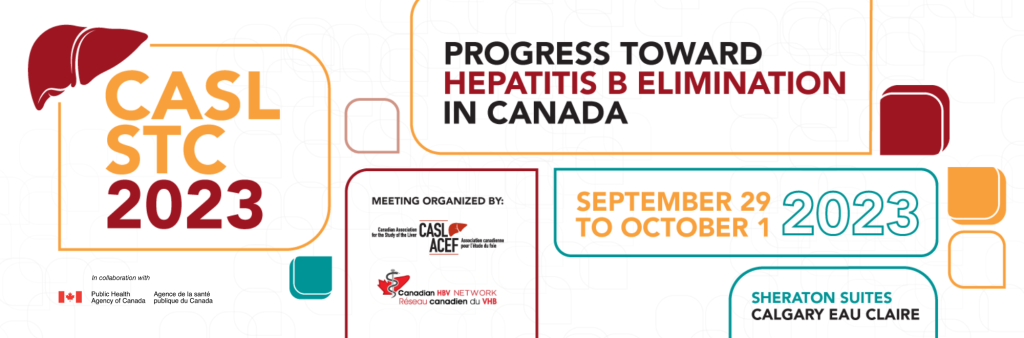
CASL Single Topic Conference – Sept. 29, 2023 in Calgary

POSTED ON: 18 Jul, 2023

On behalf of the Canadian Hepatitis B Network (CanHepB) and the Canadian Association for the Study of the Liver (CASL), we are pleased to invite you to join us at the Inaugural Progress toward Hepatitis B Elimination Meeting in Canada, September 29th-October 1st 2023.

This meeting will be a unique opportunity to exchange ideas, promote collaboration and foster knowledge translation among Canadian clinicians, laboratory providers, public health researchers, policymakers, and academic & community-based organizations with an interest in hepatitis B virus (HBV) and/or hepatitis Delta virus (HDV) coinfection.  Moreover, this inaugural meeting will support advocacy efforts in Canada to increase awareness, reduce stigma, and health care disparities, and improve the care of persons living with hepatitis B or hepatitis delta coinfection.

Despite the availability of an effective vaccine for over 4 decades, hepatitis B continues to impact over 300 million people globally and at least 250,000 Canadians. Hepatitis B is the major global cause of end-stage liver disease and liver cancer. Every 30 seconds someone dies from hepatitis B.  Current oral antiviral therapy reduces liver disease risk but cannot cure hepatitis B, thus requiring lifelong and often expensive treatment.

There is a global race to find a cure for hepatitis B.  While we await a cure, Canada needs to develop a nationally coordinated strategy to prevent hepatitis B, identify affected persons, and improve access to care and life-saving treatment.

For the first time, our program will bring together national and global leaders in hepatitis B to discuss how Canada can address this major public health threat.

Sincerely,

REGISTER NOW


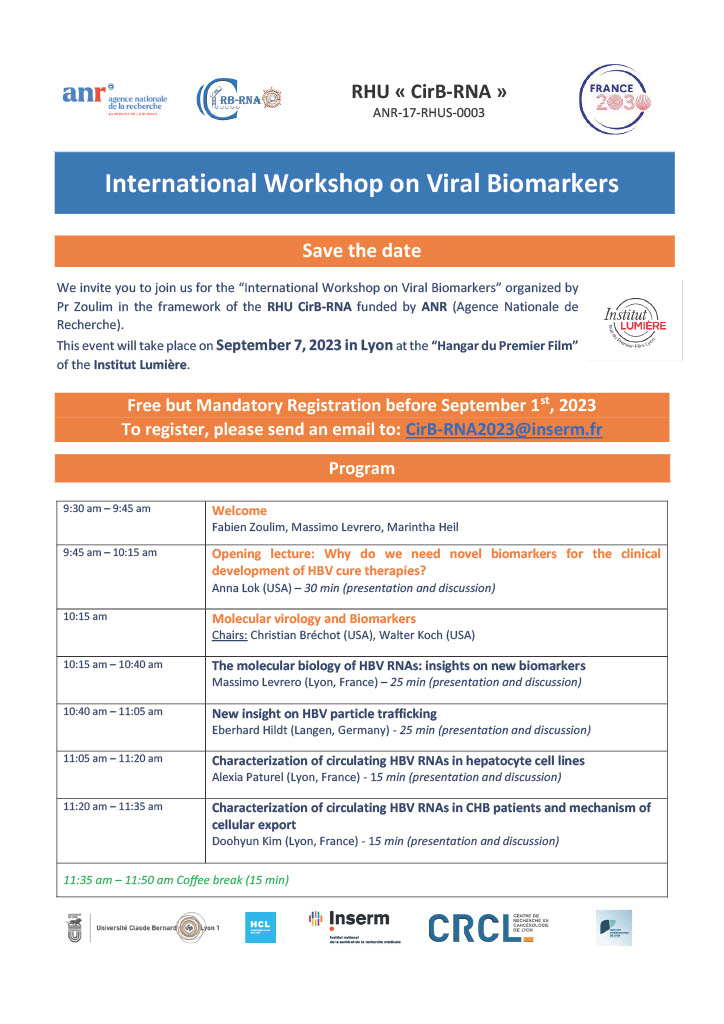
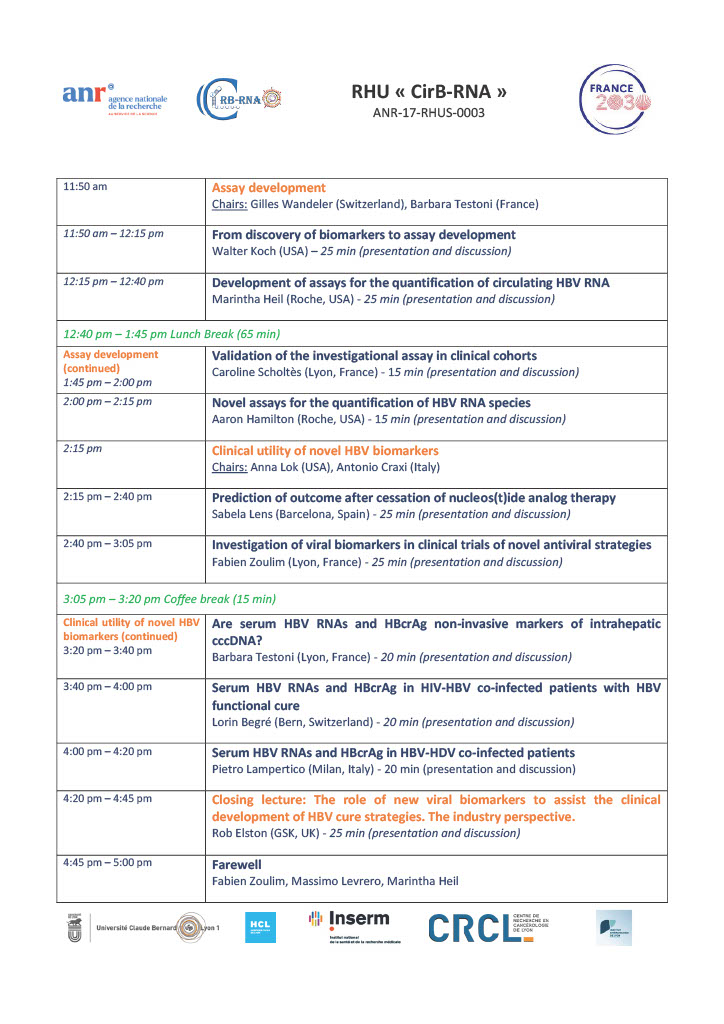
International Workshop on Viral Biomarkers – Sept. 7, 2023 in LYON

POSTED ON: 19 Jun, 2023

We are delighted to announce that ICE-HBV, as a long-standing partner, will be participating in the International Workshop on viral biomarkers organized by Pr. Fabien Zoulim as part of the CirB-RNA RHU, funded by the ANRS (French national public research agency). The event is scheduled to take place on Thursday, September 7, 2023, at the Institut Lumière, located at 15 Rue du Premier Film, 69008 Lyon, France. The deadline for registration is September 1st, 2023.

Seize this opportunity to engage, learn, and network with leading experts in the field.


PROGRAM AND REGISTRATION AT:

https://www.cirb-rna.fr/workshop-september-2023-lyon-france.html


REGISTRATION FORM:

  • LAST NAME:
  • FIRST NAME:
  • INSTITUTION/COMPANY:
  • DEPARTMENT/SERVICE:
  • CITY, COUNTRY:
  • PROFESSIONAL PHONE NUMBER:
  • PROFESSIONAL EMAIL:

Deadline for registration: September 1st, 2023

Please send the registration form to: CirB-RNA2023@inserm.fr 


Global HDV Elimination: Challenges and Opportunities Webinar – July 20th, 2023

POSTED ON: 19 Jun, 2023


Join the Coalition for Global Hepatitis Elimination and ICE-HBV for a compelling webinar on July 20th from 10:00 am to 11:30 am ET. This webinar aims to provide a comprehensive overview of the current global status of hepatitis D (HDV) elimination. With the availability of new therapeutic options, the webinar will review the burden of HDV, testing challenges, advancements in therapy, and recent insights gained from Bulevirtide. Don’t miss this opportunity to stay informed.


Register now at:

https://taskforce-org.zoom.us/webinar/register/WN_0mIb6otsTYOl3EerjDyHYQ#/registration

Webpage:

 https://www.globalhep.org/webinars/global-hdv-elimination-challenges-and-opportunities


Nomenclature of HBV core protein-targeting antivirals (HBV Forum & ICE-HBV Collaboration)

POSTED ON: 25 Nov, 2022

A greater understanding of the hepatitis B virus (HBV)
replication cycle has led to novel antiviral targets, interfering
with nucleocapsid assembly and disassembly.
In its role as a viral structural protein, the core protein
(HBc) forms a capsid of 120 HBc dimers that packages
the viral genome. Assembly agonists favour formation
of aberrant capsids or morphologically normal capsids
devoid of genetic material1. A number of such ‘capsid
assembly modulators’ (CAMs) are in clinical development.
However, a lack of consistent nomenclature
for these drugs has generated confusion. Compounds
targeting HBc have been described as CAMs, core
protein allosteric modulators (CpAMs), core or capsid
inhibitors, core-targeting agents, and as subclasses
(with inconsistent use on what is class 1 or 2, CAM-A
(aberrant), CAM-E (empty) and CAM-N (normal))2.
As HBc-targeting compounds are undergoing clinical
trials, a consistent classification would improve clarity.
To address the need for a convention that appropriately
categorizes these molecules and provides clear,
precise language to document their development, the
HBV Forum and ICE-HBV jointly convened a working
group (Supplementary Box 1) to develop a standardized
nomenclature that accommodates mechanisms of action
(MOAs) whilst being simple, intuitive and accessible.

 Read more here.